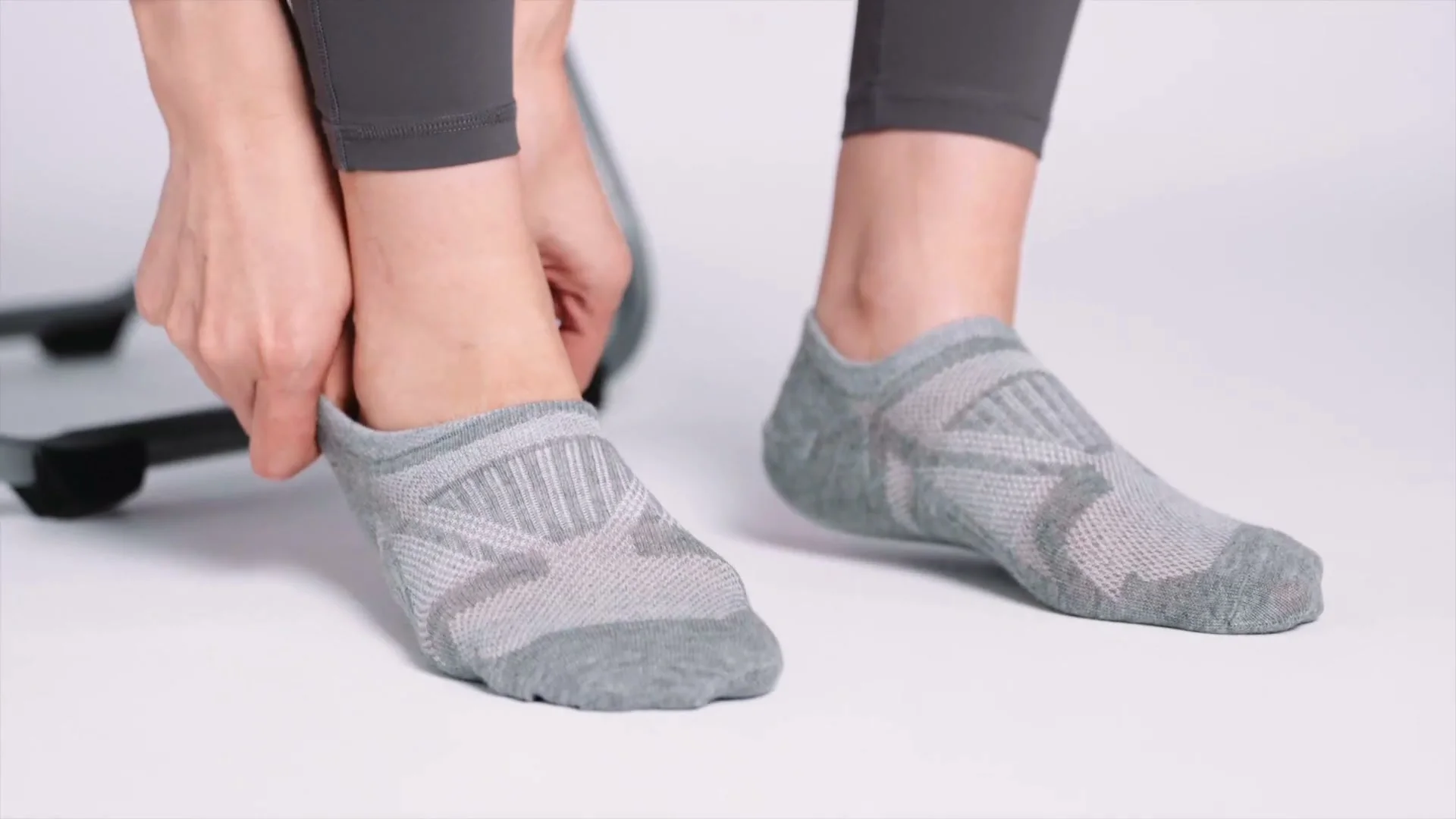
By ten in the morning the sock is a damp roll under your arch, and you are hopping on one foot in a hallway trying to fish it out. It is tempting to blame the brand and buy another pack. Before you do, it helps to know what pulls a no show sock off, because the same three or four things do it in almost every shoe.
The moment your heel lifts
Watch your foot as you walk in a sneaker. With every step the heel rises a little inside the shoe, and the stiff cup at the back of the shoe, the heel counter, stays where it is. The back of the sock sits between the two. If it sticks to the shoe more than to your skin, it gets pulled down a few millimeters. Repeat that a few thousand times and the sock has crawled under your foot.
A low cut makes this worse, not because the sock is badly made but because there is less of it. A crew sock has a whole cuff above the ankle holding it up. A no show sock has a narrow strip of fabric behind the heel and an elastic opening. Everything that keeps it in place has to happen in that strip.
Size comes first
A sock that is too small is stretched from the toe. That tension runs back along the foot and drags the heel of the sock forward, so its back edge sits low before you have taken a step. Once it sits low, the shoe needs very little help to finish the job.
Our socks are sold in US shoe size ranges, such as 5 to 8 and 8 to 11, or 6 to 10 and 11 to 13 for men. Pick the range that contains your usual shoe size. If your size sits where two ranges meet, take the larger one. Two of our models, the women's cushioned mesh and the men's cotton no show, say exactly that in their own descriptions. A sock that is a little long still lines its heel up with yours. One that is short never does.
What the silicone strips in the heel do
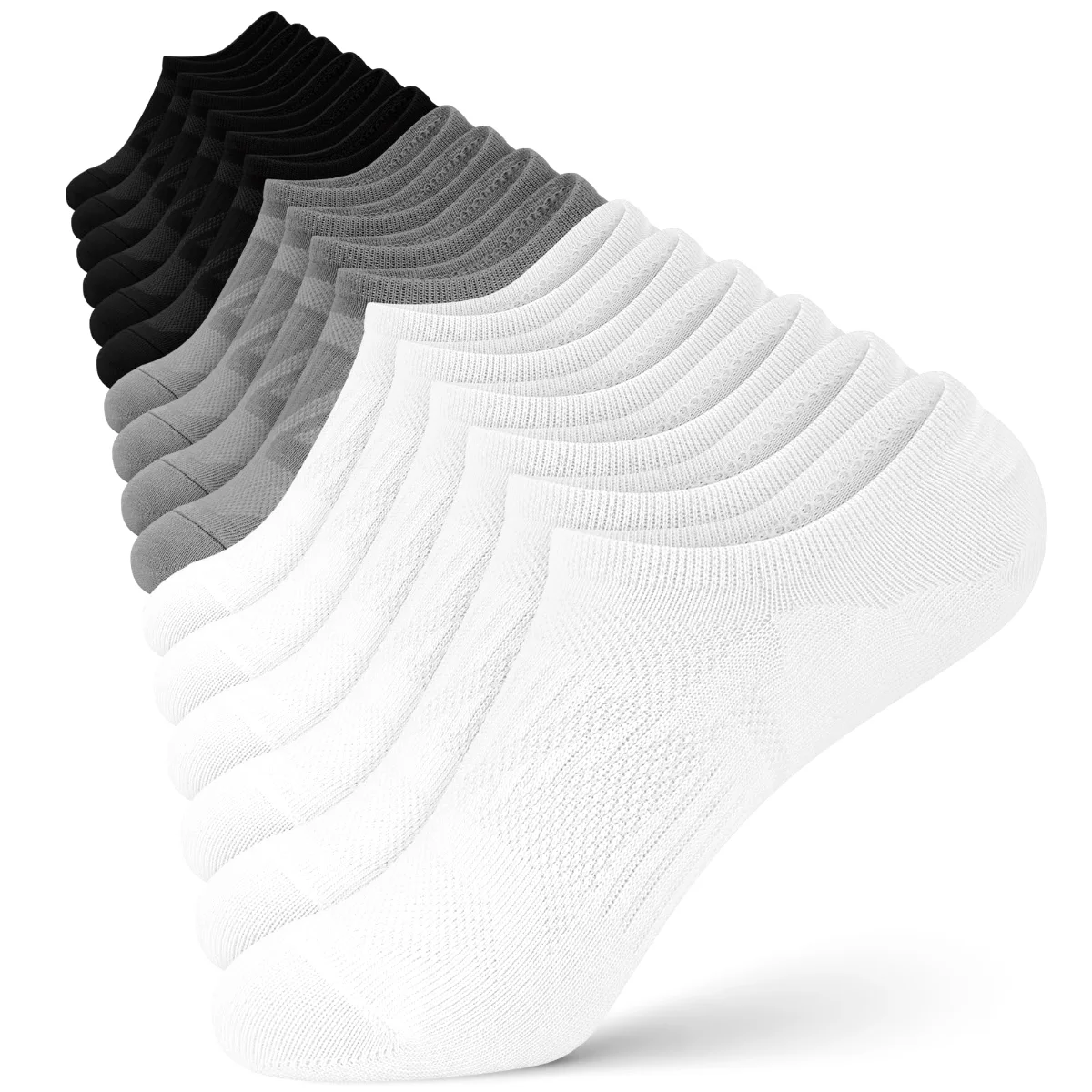
Wernies Cushioned Mesh No Show Socks
Women's · Low cut no show · US 5–8 and 9–12 · 6 packs
From $9.99Turn one of our no show socks inside out and you will see soft silicone strips across the inside of the heel. They grip skin better than cotton does, and they do their work at the moment the heel lifts, when a plain sock starts to slide. Most of our models have three strips. The women's cushioned mesh model has a four-layer strip, and the everyday mesh model has three layers of soft gel.
Two of our men's models, the mesh sport and the cotton no show, add a Y-shaped heel. The seam is cut to wrap the back of the foot rather than sit across it, so the silicone has a better-fitting pocket to hold from.
Silicone is not magic, though. It works on a sock that fits, in a shoe with the right height, with elastic that still springs back. Take any one of those away and the strips can only delay the slide.
Match the cut to the shoe
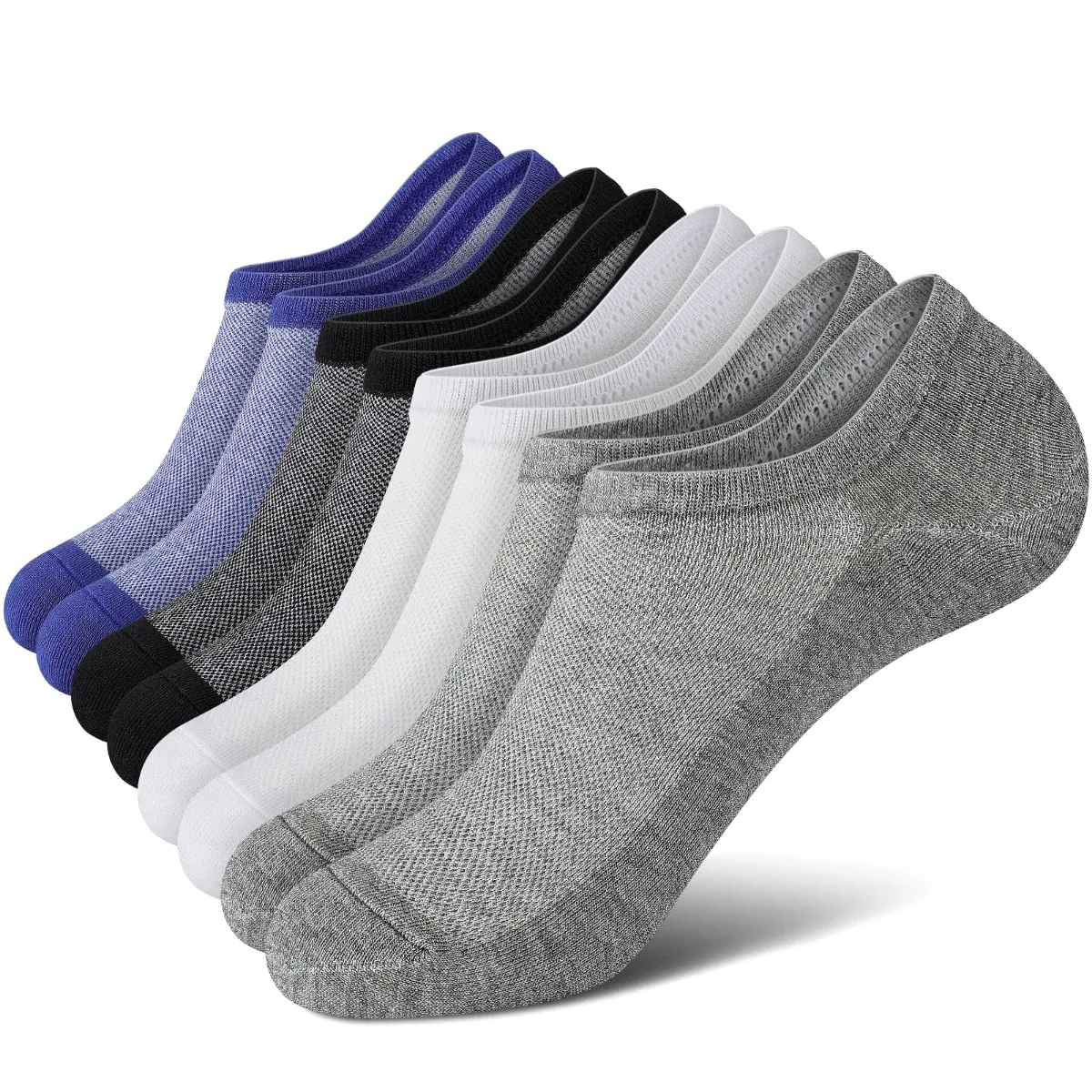
Wernies Men's Classic No Show Socks
Men's · Low cut no show · US 6–10 and 11–13 · 9 packs
From $9.99A no show sock stays hidden and stays on when its opening sits below the collar of the shoe. Sneakers, loafers and athletic shoes give it room to do that. Ballet flats and extra-low slip-ons often do not. Our classic women's low cut sock says plainly that it is not a super low sock for flats, and its edge can show in those shoes. The cushioned mesh model is not meant for extra-low slip-ons or high heels either.
On the men's side, our classic no show socks are cut for boat shoes, sneakers, oxfords and loafers. The men's cotton no show is meant for sneakers and athletic shoes, and not for boat shoes or extra-low-topped shoes. If a model keeps slipping in one pair of shoes and not in another, the shoe is usually the reason.
Wear and washing
The elastic around the opening is what keeps the sock snug against your ankle, and heat is hard on it. Hot washes and a hot dryer make the opening lazy over time, and a lazy opening lets the whole sock drift. Wash your socks inside out, in cold or warm water, and dry them flat or on low heat. The strips last longer that way too.
Read the care instructions on the back of the pack before the first wash, since a sock has no label sewn inside. The sock care guide and our journal piece on washing no show socks go through the rest.
Unsure about a size or a pack? Write to heelgrip@wernies.net and the people at Wernies will answer.